Sure Chemical Co., Ltd. Shijiazhuang

   
Home
 
About
Our Company
1 News
 
Products
Concrete Admixtures
1 Mining Chemicals
1 Personal Care Ingredients
1 Agricultural Fertilizers
1 Food Additives
Water Treatment Chemicals
Other Chemicals
Findings
1 New Product Notice
1 Research Progress
Contact
info@surechemical.com
86-311-85697096


Key Factors Affecting Concrete Durability and Strategies for Improvement

I. Factors Affecting Concrete Durability

1. Intrinsic Factors of Concrete

(1) Type and Quality of Cement
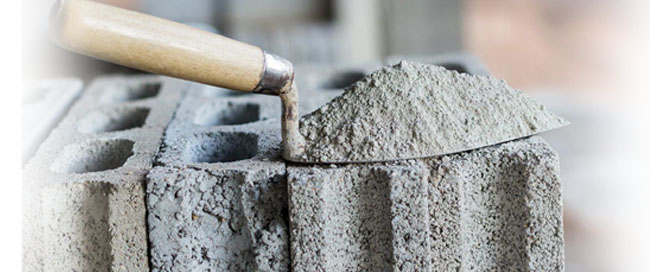
Different types of cement exhibit varied performance characteristics. For instance, slag cement offers superior resistance to sulfate attack but has lower early strength, whereas ordinary Portland cement provides high early strength and good frost resistance. Poor cement quality can lead to inadequate concrete strength and reduced durability.

1

(2)   Water-Cement Ratio
The water-cement ratio is a critical factor influencing durability. A higher ratio increases porosity and reduces compactness, leading to poor impermeability and frost resistance, making it easier for aggressive substances to penetrate the concrete.

(3)   Aggregate Quality
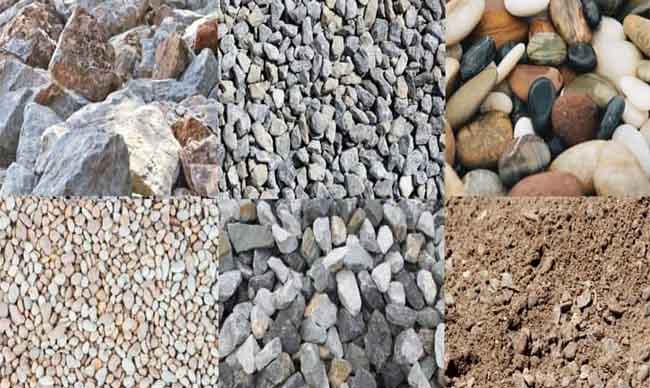
Aggregate properties such as particle size, gradation, and clay content significantly impact concrete performance. Well-graded and appropriately sized aggregates improve compactness, while high clay content reduces both strength and durability.

(4)   Admixtures and Supplementary Cementitious Materials (SCMs)
Proper use of high-quality admixtures and SCMs can enhance concrete performance. Water-reducing agents lower the water-cement ratio and increase density; fly ash and slag improve impermeability and resistance to chemical attack. However, improper usage may negatively affect durability.

1

2. Construction-Related Factors

(1)   Mixing and Placement
Inadequate mixing leads to uneven distribution of components, affecting overall performance. Poor compaction during placement can result in defects like honeycombing and surface voids, which reduce compactness and impermeability.

(2)   Curing Conditions
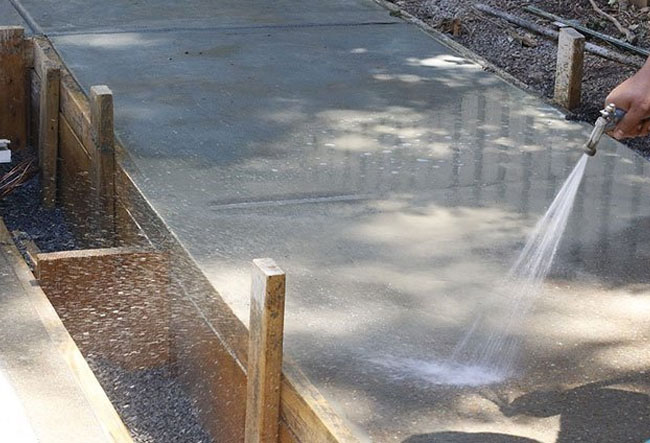
Proper curing is vital for strength development and durability. Delayed or insufficient curing, or improper control of humidity and temperature, can cause early dehydration and shrinkage cracks, undermining durability.

1

3. Environmental Factors

(1) Chemical Attack
Exposure to aggressive chemicals such as acids, alkalis, and salts can trigger reactions that decompose the cement matrix and damage aggregates. For example, sulfate attack causes expansion and cracking.

(2)   Freeze-Thaw Cycles
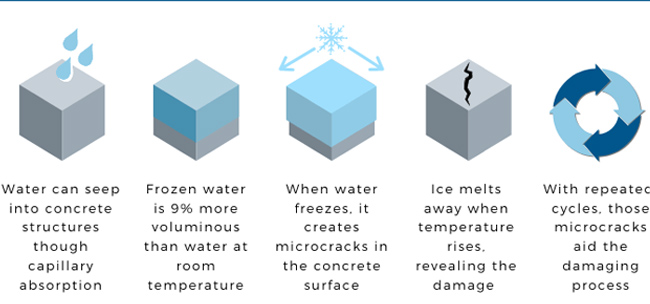
In cold regions, water in the concrete’s pores freezes and expands, then contracts upon thawing. Repeated freeze-thaw cycles gradually destroy the internal structure, reducing durability.

(3)   Carbonation
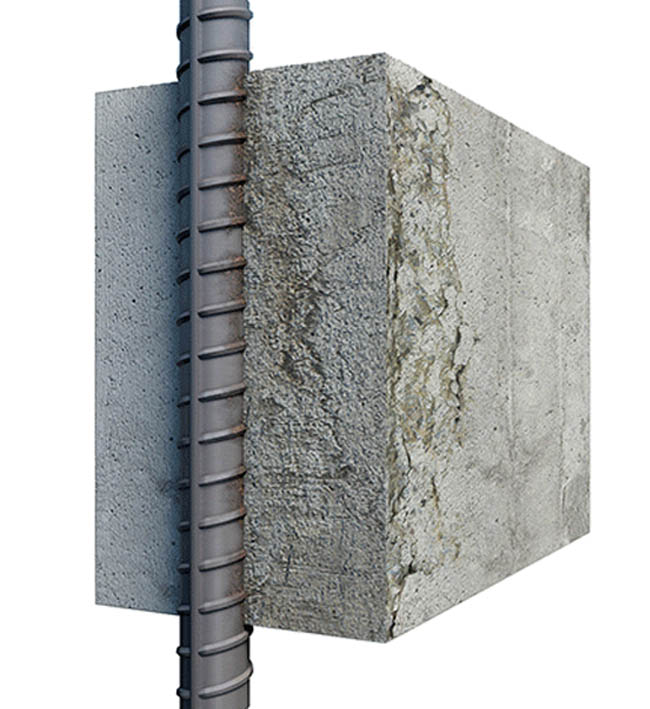
Carbon dioxide in the air reacts with calcium hydroxide in concrete, lowering its alkalinity. This damages the protective layer around reinforcement steel, leading to corrosion and compromising structural integrity.

(4)   Abrasion and Erosion
Structures such as roads and hydraulic systems often face abrasion from vehicles or erosion by flowing water. Over time, this wears away the concrete surface and exposes the inner structure, reducing durability.

II. Strategies to Improve Concrete Durability

1. Selection of Appropriate Materials

(1) Cement
Choose the right type based on environmental conditions—for example, sulfate-resistant cement in sulfate-rich environments and ordinary Portland cement for general structures.

(2)   Aggregate
Use well-graded, clean, and hard-textured aggregates. Strictly control clay, silt, and harmful substance content.

(3)   SCMs
Proper use of fly ash, slag powder, and silica fume helps refine pore structure, increase compactness, and improve resistance to water and chemical penetration.

(4)   Admixtures
Water-reducing agents help lower the water-cement ratio. Air-entraining agents introduce fine and uniform bubbles, enhancing frost resistance and impermeability.

11

2. Optimizing Mix Design

(1) Control of Water-Cement Ratio
Maintain a low water-cement ratio suitable for both strength and durability requirements. Avoid excessively high ratios to ensure compactness.

(2)   Proper Cement Dosage
Ensure the cement content is sufficient to meet strength and durability needs without excessive amounts that could lead to shrinkage.

3. Improved Construction Practices

(1) Mixing and Compaction
Use proper mixing techniques to ensure uniformity. Vibrate adequately during placement to avoid defects and improve density.

(2)   Curing
Implement effective curing practices to maintain suitable temperature and humidity, supporting strength development and minimizing shrinkage cracks.

4. Enhanced Protective Measures

(1) Surface Protection
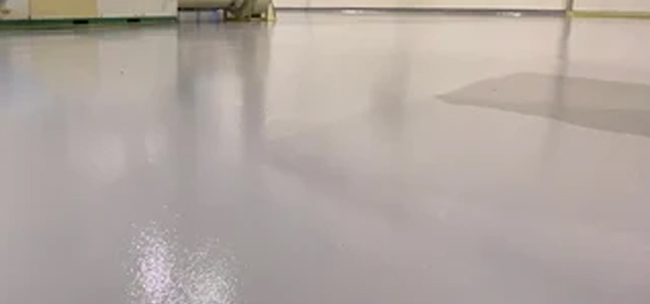
Apply protective coatings such as epoxy or polyurethane to prevent the ingress of harmful substances.

(2)   Reinforcement Protection Layer
Ensure the reinforcement is adequately covered with concrete to prevent corrosion and extend the structure’s service life.


Introduction of Cement Content-reducing Admixture (II): Technical Analysis of Cement Content-Reducing Admixtures

Introduction of Cement Content-reducing Admixture (I): The role of Cement Content-reducing Admixture and its influence on concrete strength

Comprehensive Analysis of Powder Water-Reducing Admixtures

Incorporation Methods and Considerations for Functional Concrete Admixtures

Several considerations for selecting functional concrete materials

Boosting Concrete Efficiency: The Power of Admixture Synergy

The Role of Silica Fume in UHPC

Enhancing Concrete Quality: Strategies to Address Common Issues with Water-Reducing Admixtures

Polycarboxylate Superplasticizers in Concrete: Addressing Common Challenges and Implementing Effective Solutions

Optimizing Admixture Compatibility for Robust Concrete: Strategies to Enhance Durability and Workability

Research on the Impact of Solid Content in Water-Reducing Admixtures on Concrete Performance

Delayed Setting and Hard Crust Phenomenon in Concrete

The effect of polycarboxylate superplasticizer on the strength and hydration performance of alkali slag building materials

Mastering Water Reducers: Expert Solutions for Six Types of 'Problem' Cement

Optimizing Concrete with Polycarboxylate Superplasticizers: Tackling Challenges and Boosting Performance

Ensuring High-Quality Concrete: Tackling Bleeding, Segregation, and Paste Bleeding in Concrete Mixtures

Unlocking the Secrets of Polycarboxylate Superplasticizers: Synthesis and Advanced Dispersing Mechanisms Demystified

Optimizing Concrete Performance with Polycarboxylate Superplasticizers: A Comprehensive Guide to Spring Season Adjustments

The adaptability of polycarboxylic acid admixture and other raw materials of concrete

Research on Concrete Admixture testing and its application

Causes and prevention measures of 8 appearance defects of concrete structures

Precautions when using polycarboxylate superplasticizer(PCE) in concrete

The role of defoaming agents in Concrete

Regarding the compound raw materials of polycarboxylate water-reducing agent

Three Key Considerations for Additive Usage in Concrete Production

Fiber Reinforced Concrete: Types, Properties and Applications

Some common problems in the application of PCE

About the overdosage of concrete water reducer

How to deal with mildew of Polycarboxylate Superplasticizer

Effects of Admixtures and Admixtures on the Properties of Cement Concrete

Common problems and analysis of polycarboxylate water reducer in ready-mixed concrete

Retarders and Concrete Setting

How to select and use concrete admixtures

Tips of application of polycarboxylate high-performance water reducer(VII)

Tips of application of polycarboxylate high-performance water reducer(VI)

Tips of application of polycarboxylate high-performance water reducer(V)

Tips of application of polycarboxylate high-performance water reducer(IV)

Tips of application of polycarboxylate high-performance water reducer(III)

Tips of application of polycarboxylate high-performance water reducer(II)

Tips of application of polycarboxylate high-performance water reducer(I)

The quality of concrete can be improved with the help of burnt straw.

The price of concrete admixture’s raw materials is rising rapidly recently!

About Polyether Macromonomers and Polycarboxylate Superplasticizer(PCE)

Suggestion on "The Slump loss of concrete by using polycarboxylate superplasticizer (PCE) "

The 23 most popular Concrete Admixtures of global market

Polycarboxylate Superplasticizer (PCE) 50% liquid export to Russia under the COVID-19 pandemic

Polycarboxylate superplasticier 50% liquid  export to Vietnam in Flexi bag

TPEG+HPEG export to Middle East market

Polycarboxylate superplasticizer +shrinkage-reducing agent +defoaming agent +air-entraining agent

We made a speech at PCE 2019 !

PCE heat resistant grade export to Russian market

PCE powder export to Indonesia !

Flexi bag: A new package for polycarboxylate superplasticizer 50% liquid  (POLYETHERS IN PRIMARY FORMS)

PCE Introduction download

Descargar la introduccion

The quality of concrete can be improved with the help of burnt straw.

NOR containers help to save the cost at so high sea freight level !

The 23 most popular Concrete Admixtures of global market

SNF 3% EXPORTED

Sodium Naphthalene formaldehyde loaded today for PT.Kao indonesia on this weekend vessel.


Copyright (C)2009 Sure Chemical Co., Ltd. Shijiazhuang