Fiber Reinforced Concrete: Types, Properties and Applications
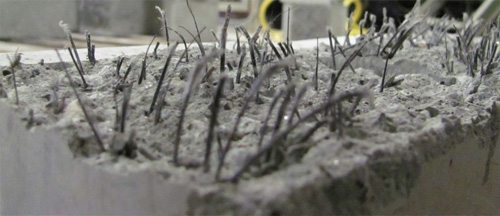
Understanding fiber reinforced concrete Fiber reinforced concrete, or fiber concrete for short, is a cement-based composite material composed of cement paste, mortar or concrete as the matrix and discontinuous short fibers or continuous long fibers as the reinforcing materials. The main disadvantages of cement paste, mortar and concrete are low tensile strength, small ultimate strain, and brittleness. Adding fibers with high tensile strength, large ultimate strain, and good alkali resistance can overcome these disadvantages. Fibers can control the further development of cracks in the matrix concrete, thus improving the crack resistance. Because of the high tensile strength, large strain, and good alkali resistance of the fibers, the tensile, flexural, impact strength and strain and toughness of the concrete are improved.
I Function
Various fibers have different degrees of improvement on the permeability, freeze-thaw resistance, chloride ion penetration resistance and carbonation resistance of concrete. The effects of adding fibers to the cement matrix include the following aspects:
1.Crack prevention. Prevent the expansion of existing defects (microcracks) in the cement matrix and effectively delay the appearance of new cracks;
2.Anti-seepage. Improve the compactness of the cement matrix by preventing cracks and prevent external moisture from invading;
3.Durability. Improve the freeze-thaw resistance, fatigue resistance and other properties of the cement matrix and increase its durability;
4.Impact resistance. Improve the ability of the cement matrix to withstand deformation, thus improving its toughness and impact resistance;
5.Tensile strength. Under the premise of using high elastic modulus fibers, it can play a role in improving the tensile strength of the matrix;
6.Aesthetics. Improve the appearance of cement structures, making them more dense, fine, smooth and beautiful.
II Classification
1.According to their fiber material properties, they can be divided into three types:
(1)Metal fibers. Such as steel fibers (steel fiber concrete), stainless steel fibers (suitable for heat-resistant concrete).
(2)Inorganic fibers. Mainly include natural mineral fibers (warm asbestos, blue asbestos, iron asbestos, etc.) and man-made mineral fibers (alkali-resistant glass fibers and alkali-resistant mineral wool carbon fibers).
(3)Organic fibers. Mainly include synthetic fibers (polyethylene, polypropylene, polyvinyl alcohol, nylon, aromatic polyamide, etc.) and plant fibers (sisal hemp, agave, etc.). Synthetic fiber concrete should not be used in hot environments above 60°C. Fiber concrete has many advantages compared with ordinary concrete, but it cannot replace reinforced concrete after all. People began to add fibers to reinforced concrete with steel bars to make it a reinforced-fiber composite concrete, which opened up a new way for the application of fiber concrete.
2.According to the elastic modulus of the fiber, it can be divided into two types:
(1)Flexible fiber: The fiber with elastic modulus lower than that of the cement matrix is called flexible fiber, such as polypropylene fiber, nylon fiber, cellulose fiber;
(2)Rigid fiber: The fiber with elastic modulus higher than that of the matrix is called rigid fiber, such as steel fiber, glass fiber, carbon fiber, etc.
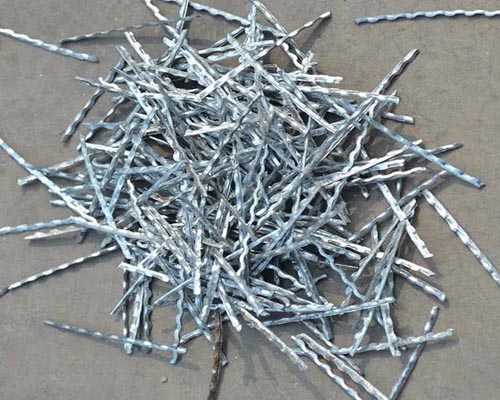
Concrete prepared by adding an appropriate amount of steel fibers to ordinary concrete is called steel fibers concrete or steel fiber reinforced concrete. Compared with ordinary concrete, its tensile strength, flexural strength, wear resistance, impact resistance, fatigue resistance, toughness, crack resistance and explosion resistance are greatly improved. Because it enhances the bond force with the concrete matrix, it has a significant effect on crack prevention, reinforcement and toughening of concrete products and is gradually widely used in engineering.
Steel fibers concrete also has some drawbacks such as steel fibers tend to agglomerate during mixing which makes it difficult to pump and construct; it is prone to rust; steel fibers concrete has a large self-weight; it consumes a lot of steel in manufacturing which increases costs; steel fibers are mainly pulled out during use rather than broken which indicates that steel fibers have insufficient adhesion with concrete which affects improving tensile strength; in addition during construction steel fibers have a high density which often sinks to the lower part of the concrete during vibration casting which makes it impossible to distribute evenly affecting actual application effects.
2.Carbon fiber concrete
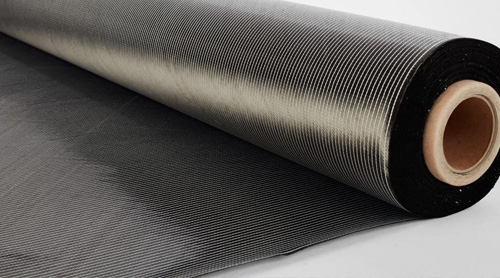
Carbon fiber is a high-performance fiber developed in the 1960s. It has high tensile strength and elastic modulus stable chemical properties good bond with concrete but its high price limits its engineering application.
Carbon fiber concrete is a composite material that uniformly distributes carbon fibers in cement mortar or ordinary concrete matrices to increase their physical and mechanical properties. This kind of fiber concrete has high tensile strength impact resistance and fracture resistance corrosion resistance etc. By replacing steel bars with carbon fiber it can eliminate salt water degradation and deterioration effects on reinforced concrete reduce weight make installation easier shorten construction period.
Carbon fiber also has vibration damping characteristics which can absorb shock waves increase seismic capacity and flexural strength by more than ten times. Carbon fiber concrete has high tensile strength flexural strength fracture resistance corrosion resistance etc. Due to the small expansion coefficient of carbon fiber carbon fiber concrete has good heat resistance and small temperature deformation. In addition carbon fiber concrete also has good corrosion resistance permeability resistance wear resistance shrinkage resistance and durability.
3.Glass fiber concrete
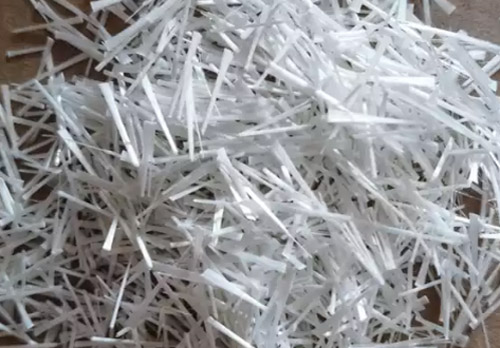
Glass fiber concrete is a composite material that uniformly distributes alkali-resistant glass fibers with large elastic modulus in cement mortar or ordinary concrete matrices. Because the diameter of glass fibers is only 5 ~ 20 μm almost close to the particles of cement when using glass fibers the binder is cement paste or fine sand is added to it and coarse aggregates with larger particle size are almost not used. Therefore the composite material made of this material is also called reinforced cement. Using glass fiber concrete is the future development direction of construction engineering. It can not only make up for the shortcomings of ordinary concrete products such as large self-weight low tensile strength poor impact resistance etc. but also has characteristics that ordinary concrete does not have. Glass fiber concrete products are thin and light. Because of the use of glass fibers with high tensile strength as reinforcing materials its tensile strength is very high. Glass fibers are evenly distributed in the concrete which can prevent surface cracking of concrete products. Because it can absorb a lot of energy when it is damaged it has excellent impact resistance and high flexural strength. In addition glass fiber concrete products have good demolding properties easy processing and can be made into various shapes of special-shaped products.
The disadvantage is that although glass fibers have been used for paving concrete pavements they have exposed a lot of shortcomings such as glass fiber concrete exposed to the atmosphere for a period of time its strength and toughness will drop significantly that is from the early high strength high toughness to ordinary concrete degradation. As we all know ordinary glass fibers have a fatal weakness that is they are not alkali-resistant so ordinary glass fibers cannot be used as reinforcing materials for cement concrete even alkali-resistant glass fibers (AR) are not suitable for compounding with ordinary Portland cement it is best to compound with low-alkali cement and alkali-resistant glass fibers are difficult to distinguish from ordinary glass fibers in appearance which has been difficult to promote on a large scale for decades.
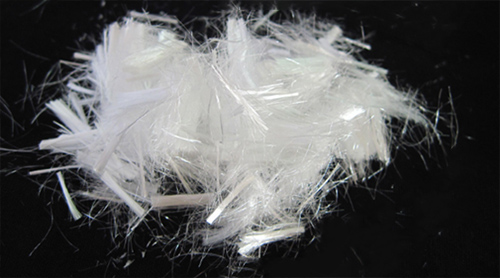
4.Synthetic fiber concrete Synthetic fibers include polypropylene fibers polyester and polyacrylonitrile fibers etc. It has similarities with steel fibers such as not being eroded by hydration products having a certain tensile strength and can be distributed in three dimensions in the concrete matrix. The principle of crack prevention is to give full play to the advantages of the number of fibers (tens of millions per kilogram) which have a large surface area restrain microcracks and prevent them from communicating which has a significant effect. However synthetic fibers have low density small single filament diameter increased thickening effect which is not conducive to the vibration compaction of concrete and due to the low tensile strength of synthetic fibers their failure mode is mainly fiber breakage during use and they are not good enough in anti-aging and alkali resistance.
Polypropylene fiber concrete is the most researched and applied concrete. Polypropylene fibers concrete is a composite material that uniformly distributes polypropylene fibers cut into a certain length in cement mortar or ordinary concrete matrices to enhance their physical and mechanical properties. This kind of fiber concrete has light weight high tensile strength impact resistance and crack resistance etc. It can also replace some steel bars with polypropylene fibers to reduce the self-weight of concrete thereby increasing the seismic capacity of the structure.
According to different shapes and structures polypropylene fibers can be divided into monofilament fibers parallel original filamentized fiber bundles and film fibers. Monofilament fibers have a higher aspect ratio parallel original filamentized fiber bundles can be easily dispersed in the cement matrix although there is limited chemical bond connection but mechanical bond is good which can prevent the fiber from being pulled out when stressed.
Although the tensile strength of polypropylene fiber is higher than that of ordinary concrete its elastic modulus is relatively low and under high stress conditions the concrete can easily reach the ultimate deformation. But when adding an appropriate amount of polypropylene fiber this composite material has much higher impact resistance than ordinary concrete which provides a promising way for the production of components that require low load but high impact resistance and high toughness. In addition polypropylene fiber does not rust and has good acid and alkali resistance.
5.Basalt fiber concrete
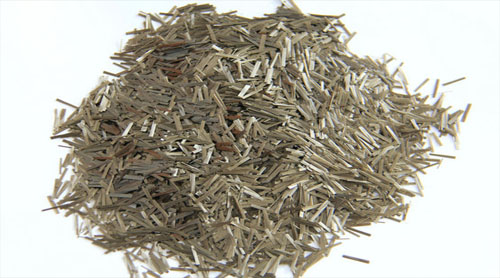
Continuous basalt fiber (CBF) is an inorganic fiber material made from pure natural volcanic rock by melting at 1450~1500°C and rapidly drawing into continuous fibers. It has an appearance of golden brown color and has excellent comprehensive performance and low price.
The characteristics of CBF are as follows:
(1)The naturalness of raw materials. Since the raw material for producing CBF depends on natural volcanic rock, it has very high chemical stability and thermal stability, and there are no harmful components to human health.
(2)The comprehensiveness of performance. Basalt fiber is a truly “multi-functional” fiber. For example, it is acid-resistant and alkali-resistant, low-temperature-resistant and high-temperature-resistant, heat-insulating and electrically insulating, and sound-proof. It has a tensile strength higher than that of large-bundle carbon fibers, and a fracture elongation better than that of small-bundle carbon fibers. CBF has a polar surface, which has excellent wettability when combined with resin, and CBF has a three-dimensional molecular dimension, which has higher compressive strength, shear strength, adaptability and anti-aging performance in harsh environments than linear polymer fibers with one-dimensional molecular dimensions.
(3)The low cost. The price of basalt fiber for cement concrete is not high, significantly lower than steel fiber, carbon fiber, etc., and comparable to synthetic fiber.
(4)The natural compatibility. Basalt fiber is a typical silicate fiber, which is easy to disperse when mixed with cement concrete and mortar. The newly mixed basalt fiber concrete has stable volume, good workability, good durability, excellent high temperature resistance, anti-seepage and crack resistance and impact resistance. Therefore, basalt fiber reinforced concrete can play a role of anti-seepage and crack prevention and extend the service life in various fields of infrastructure construction.
Compared with other fiber concretes, the new basalt fiber concrete has the following advantages:
(1)Two kinds of fibers with similar properties but different diameters can work together synergistically complementing each other’s advantages both preventing and resisting cracks and enhancing toughness and strength.
(2)Basalt fiber filaments can take advantage of the number of fibers which have a large surface area restrain microcracks and prevent them from communicating which has a significant effect. And it overcomes the disadvantages of synthetic fibers such as low density low elastic modulus and low tensile strength which prevents them from breaking during crack propagation effectively preventing the expansion of microcracks anti-seepage anti-freeze-thaw etc. better than synthetic fibers.
(3)Basalt fiber twisted strands can take advantage of the high modulus and high tensile strength of steel fibers to prevent crack propagation. It also overcomes the disadvantages of steel fibers such as easy agglomeration during mixing difficult to mix difficult to construct prone to rust poor durability heavy self-weight etc.
(4)Basalt twisted strand fiber is a typical silicate fiber with a specific gravity of 2.632.8g/cm3 which is close to the density of cement concrete and mortar easy to disperse when mixed and evenly distributed in the concrete overcoming the disadvantage that steel fiber concrete often sinks to the lower part of the concrete during vibration casting and cannot be evenly distributed.
(5)The surface of basalt fiber has been modified which is an “inert fiber” with high stability which can maintain stable performance in high temperature and high corrosion environments making basalt twisted strand fiber adaptable to the harsh environments of mixing pouring setting and using of concrete at all stages improving the durability of concrete.